Training to become an EUCERTA Internal Auditor – an inspiring start on the path to becoming a Lead Auditor
Introduction – why EUCERTA trains auditors
The EUCERTA European Certification Agency is consistently expanding its network of highly qualified, independent auditors in Europe. The goal is to support companies of all sizes in implementing and further developing ISO management systems – practically, in compliance with standards, and with a clear focus on measurable added value. This includes a structured training program from Internal Auditor to Lead Auditor in accordance with the guidelines of ISO 19011.
The partner training course “Internal Auditor” in Cologne
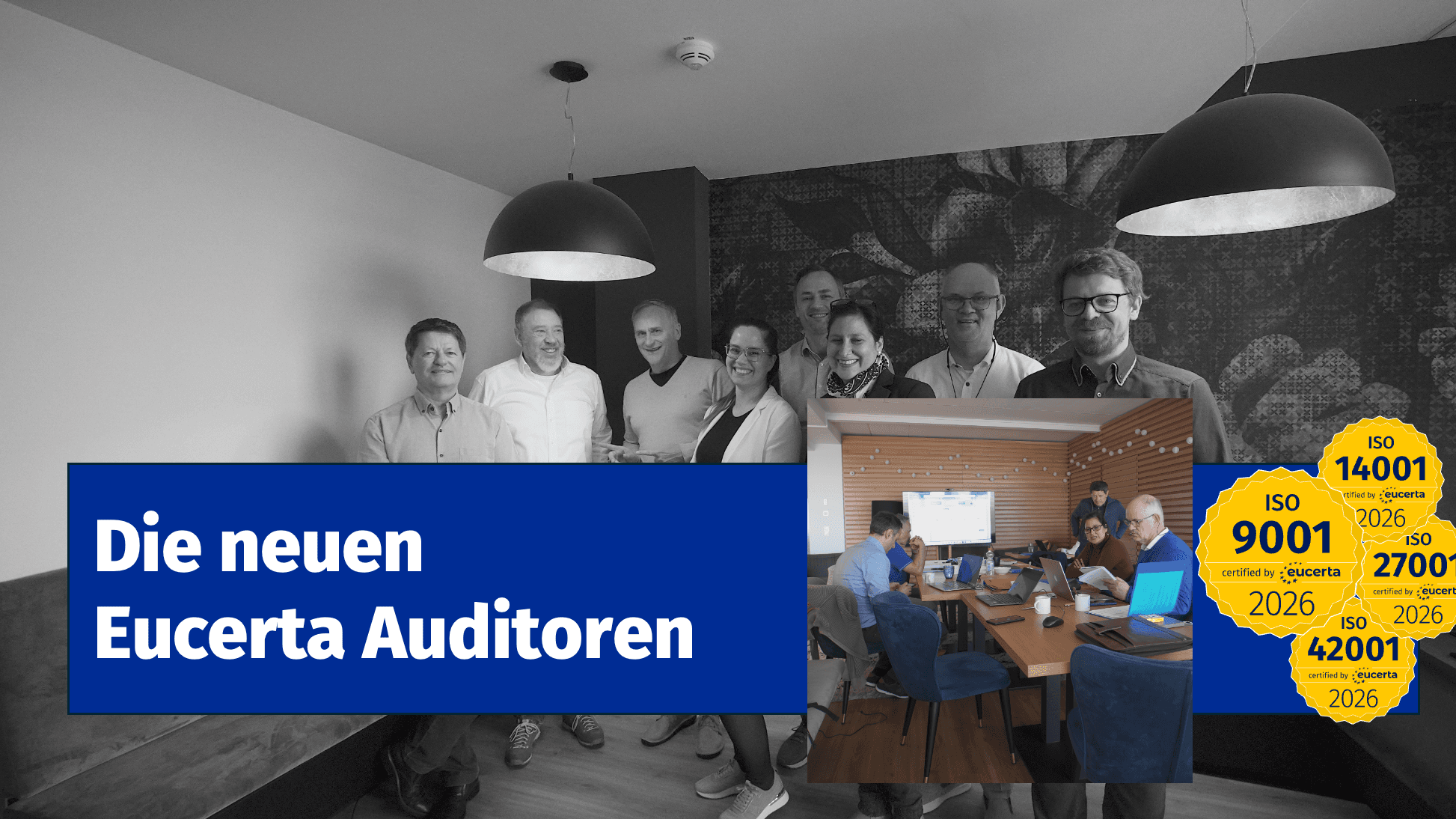
From April 7 to 10, 2026, the first partner training – Internal Auditor took place in Cologne at GoNext, Schildergasse. The list of participants included representatives from the entire EUCERTA Group – from EUCERTA AG, the EUCERTA Academy, through EUCERTA Germany to EUCERTA Spain and EUCERTA Turkey.
Already in the first few minutes it was clear how exciting and inspiring this training was for everyone involved: people from different countries, with different professional backgrounds, united by one goal – to become certified auditors who professionally assess and further develop management systems.
Content of the training – from understanding standards to conducting conversations
The four-day training was based on the requirements of ISO 19011 – Guidelines for auditing management systems, supplemented by the internal guidelines from the ECA Handbook for Auditors and Consultants. The focus was particularly on:
Standards competence – the participants learned to confidently interpret audit criteria from ISO standards (e.g. ISO 9001, ISO 14001, ISO 27001, and ISO 42001) and translate them into practical audit questions.
Audit methodology – planning audit programs, creating audit plans, selecting appropriate samples, and using remote and on-site methods.
Didactics and conversation management – how auditors conduct respectful, clear, and at the same time critical conversations with clients, properly justify observations, and constructively address even difficult topics.
Thinking in processes and risks – the participants practiced understanding management systems not as a “stack of documents,” but as a coherent process landscape with opportunities and risks.
Curiosity and a learning mindset – in keeping with the ECA values, it was emphasized that good auditors continuously develop themselves, actively seek feedback, and curiously explore new industries and technologies.
It was particularly impressive how the group translated the abstract requirements of the ISO standards into concrete case studies, role-plays, and audit simulations – from the opening meeting through interviews with “process owners” to the closing meeting with management and the audit report.
Working as a team – learning in groups
To promote exchange, the participants were divided into groups that worked together on audit tasks, developed checklists, and discussed their results in the plenary session. The mix of experienced quality managers and newcomers led to lively discussions and many changes of perspective – exactly what modern audit competence requires.
The atmosphere was consistently collegial, open, and learning-oriented: participants supported each other, shared best practices from consulting practice, and critically reflected on their own audit behavior.
Role and self-conception of the EUCERTA auditor
The ECA Handbook made clear what role EUCERTA expects its auditors to fulfill:
They work independently and in accordance with the principles of objectivity, integrity, confidentiality and professional care, as required by ISO 19011.
They are partners at eye level for customers, focusing on flexibility and practical relevance and avoiding unnecessary bureaucracy.
They use standardized audit and report templates as well as the EUCERTA intranet to document efficiently and maintain consistent quality standards.
They bear responsibility for health and safety during on‑site audits and ensure a professional yet pragmatic demeanor.
This combination of technical depth and lived values made the training not only informative but also personally inspiring: many participants saw it as a clear next step in their professional development.
From training to practice – the next step in development
The partner training is embedded in a multi‑stage qualification model of EUCERTA:
1. Internal Auditor ECA‑certified – focus on internal audits within one's own or supervised company; based on ISO 19011, ISO fundamentals and the ECA processes.
2. Lead Auditor – the next stage follows with in‑depth training with a stronger focus on audit program management, leading audit teams, evaluating complex management systems and the role of the Lead Auditor in certification.
After four intensive days in Cologne, many participants stated very clearly that they now deliberately want to continue on the path to becoming a Lead Auditor – with the goal of leading international audit projects for EUCERTA in the future.
Outlook – reunion on 28.05.2026 in Mallorca
The next highlight is already set: On 28.05.2026 the group will meet for the next training stage in Mallorca to deepen the content and work specifically towards the Lead Auditor exam.
Planned there, among other things, are
· complex multi‑site and combined audits (e.g. ISO 9001 / ISO 14001 / ISO 27001) as a simulation,
· extended exercises on the evaluation of nonconformities, handling major and minor deviations, and effective corrective actions,
· and in‑depth sessions on the competence and evaluation of auditors, as described in section 7 of ISO 19011.
Anticipation for this reunion is high: it's not just about another training, but about growing together into a professional auditor community that represents EUCERTA throughout Europe.